When the mare became restless, Megan stopped and g…
When the mare became restless, Megan stopped and gave her time rather than [clears throat] trying to force the lesson forward.
Dale leaned against the fence and observed her work.
He offered a suggestion when the mayor began drifting toward the gate, and Megan adjusted her position without taking offense.
By the end of the session, the horse was following her calmly for short stretches, though Megan knew they would need several more sessions before the behavior became reliable.
Dale seemed considerably more interested in her qualifications after that.
When Owen arrived to collect a set of tools from the barn, Dale informed him that Megan had already accomplished more with the mayor than he had expected.
He added that Owen might want to visit the train station more often if that was [clears throat] where he intended to find good employees.
Megan laughed while Owen shook his head and continued toward the equipment shed.
The first disagreement came before supper.
Megan had noticed an old hay rake parked behind the shed along with several pieces of equipment that appeared to be used infrequently.
She suggested they identify anything that could be sold without affecting operations.
Owen agreed with the general idea until she mentioned the rake.
His father had bought it secondhand when Owen was still a boy and rebuilt much of its mechanism himself.
It was no longer their primary machine, but Owen had kept it in working condition as a backup.
Megan pointed out that unused equipment still took up space and required maintenance.
Owen replied that replacing an old machine in the middle of haying season could cost considerably more than keeping it.
The discussion ended without a decision.
Later, Megan noticed an older photograph hanging beside the office door.
Owen’s father stood next to the same rake with a much younger Owen sitting on its frame and grinning at the camera.
She crossed the rake off her preliminary list of equipment to sell.
It was a small decision, but it reflected something she had begun to understand about Cedar Ridge.
The ranch was a business, yet many of its ordinary objects belonged to a family history that could not be measured entirely in dollars.
Rain moved across the valley that evening, leaving the farmhouse windows stre with water and filling the kitchen with the occasional sound of dripping from the porch roof.
Owen cooked supper while Megan finished sorting the invoices.
Dale had gone home, leaving the two of them to eat at opposite ends of the kitchen table with Gus stretched comfortably between their chairs.
Megan explained that consolidating certain orders, correcting the duplicate payments, and comparing suppliers could reduce unnecessary expenses.
Even with those improvements, she could see that the financial pressure Owen was facing went beyond inefficient purchasing.
She asked whether a substantial payment was coming due.
Owen set down his fork.
He was accustomed to discussing difficult matters when there was a clear purpose, but talking about the ranch’s debts with someone he had met only 2 days earlier felt uncomfortably personal.
There’s a payment at the end of August, he admitted.
Megan waited, giving him an opportunity to say more.
When he returned his attention to his plate, she understood that he was not ready to discuss the amount.
She did not press him.
Instead, she explained that reducing expenses would help the ranch operate more efficiently, but ordinary savings could not be expected to resolve a major financial obligation within a few months.
Eventually, they would need to examine the wider business, its income, and what resources were available.
Owen nodded. He had known that for some time, although hearing it from another person made the problem harder to set aside.
The next morning brought clear skies and cold air that smelled of wet grass.
Megan was already in the office when Owen came downstairs, having started a spreadsheet to compare feed prices, delivery schedules, and monthly purchasing costs.
She spent part of the day contacting suppliers and confirming the duplicate payments.
One agreed to issue a credit while the other requested copies of the relevant records before making a correction.
[clears throat] By the afternoon, she had prepared a practical list of changes that could be introduced without disrupting the work Dale and Owen were already doing.
She also separated the suggestions that required additional information from those that could be implemented immediately.
Owen read through her notes at the kitchen table.
He did not agree with every recommendation, but he could see that Megan had taken the time to understand how the ranch operated before proposing changes.
Her experience was useful, and the way she handled disagreement made it easier for him to consider ideas he might otherwise have dismissed.
Before supper, he offered her a 4-week position as a part-time operations coordinator.
The arrangement would provide approximately 24 paid hours each week at the same hourly rate, with her room available for the duration of the agreement.
Megan considered the proposal carefully.
She had left Spokane intending to put some distance between herself and the life she had spent nearly 7 years building.
During that time, she and [clears throat] her former boyfriend had operated a horseboarding and training business together.
They had started modestly, expanded gradually, and eventually reached a point where she believed they had created something permanent.

Her boyfriend had begun making plans for a different business long before he admitted he wanted to leave.
When their disagreements finally became impossible to ignore, the partnership and their relationship ended within the same difficult period.
Megan had received the money and property legally owed to her, but the settlement did little to replace the work that had structured her days or the future she had expected to share with someone.
Her parents still lived in Spokane and would have welcomed her home.
She loved them, but she had no desire to return to her childhood bedroom while everyone she knew offered advice about what she ought to do next.
Her aunt in Shelby had offered her a place to stay while she considered her options.
Until arriving at Cedar Ridge, Megan had been willing to accept that arrangement simply because she could think of nothing better.
Now she had the possibility of doing familiar work in a place where nobody expected her to explain what had gone wrong.
She accepted Owen’s offer. He thanked her, then made a note to prepare the employment paperwork.
Megan smiled at the seriousness with which he approached an arrangement they had already discussed in considerable detail.
Over the next few days, the farmhouse developed a routine that was new to both of them.
Megan worked through the purchasing records each morning, spent time with the horses when Dale needed assistance, and gradually learned where Owen kept the tools, spare keys, and supplies.
Gus became particularly interested in the changes.
He began sleeping beside Megan’s desk during the afternoon, although he still followed Owen whenever there was work to be done outside.
One morning, Megan opened her bedroom door and discovered one of Owen’s boots placed neatly on the floor.
Gus sat several feet away, watching her with evident satisfaction.
When she carried the boot into the kitchen, Owen took one look at it and called the dog over.
Gus obeyed immediately, then settled beside Megan’s chair as if the matter had nothing to do with him.
The incident gave them something to laugh about over breakfast, but Owen remained careful about allowing their growing familiarity to become something he did not yet understand.
He liked having Megan at Cedar Ridge.
He appreciated her practical judgment, her willingness to work, and the way she treated Dale without making him feel that his age had diminished his value.
Nevertheless, the disappointment of Vanessa’s letter was still recent, and Owen had no intention of confusing gratitude with the beginning of another relationship.
On Saturday evening, after the supper dishes were put away, he sat at the kitchen table with his phone beside an unfinished cup of coffee.
For 8 months, Saturday had been the evening when Vanessa called.
Owen had often arranged his work around those conversations, sometimes finishing late in the barn so that he [clears throat] could be inside when the telephone rang.
This time, there was no call.
From the other room came the quiet sound of Megan turning pages, followed by the familiar tapping of Gus’s nails as he followed her across the floor.
Owen looked toward the doorway, then returned his attention to the phone.
It took him a little while to put it away.
The Sunday after Megan agreed to stay, Owen found her in the kitchen with a cup of coffee and a notebook open beside the window.
She had no work scheduled that morning, but she was making a list of things she needed from town, including a better pair of gloves and a replacement charger for her laptop.
Owen had already been outside to feed the horses.
Gus followed him into the kitchen, stopped beside Megan’s chair, and waited until she acknowledged him with a scratch behind the ears.
Owen noticed the flowers on the window sill.
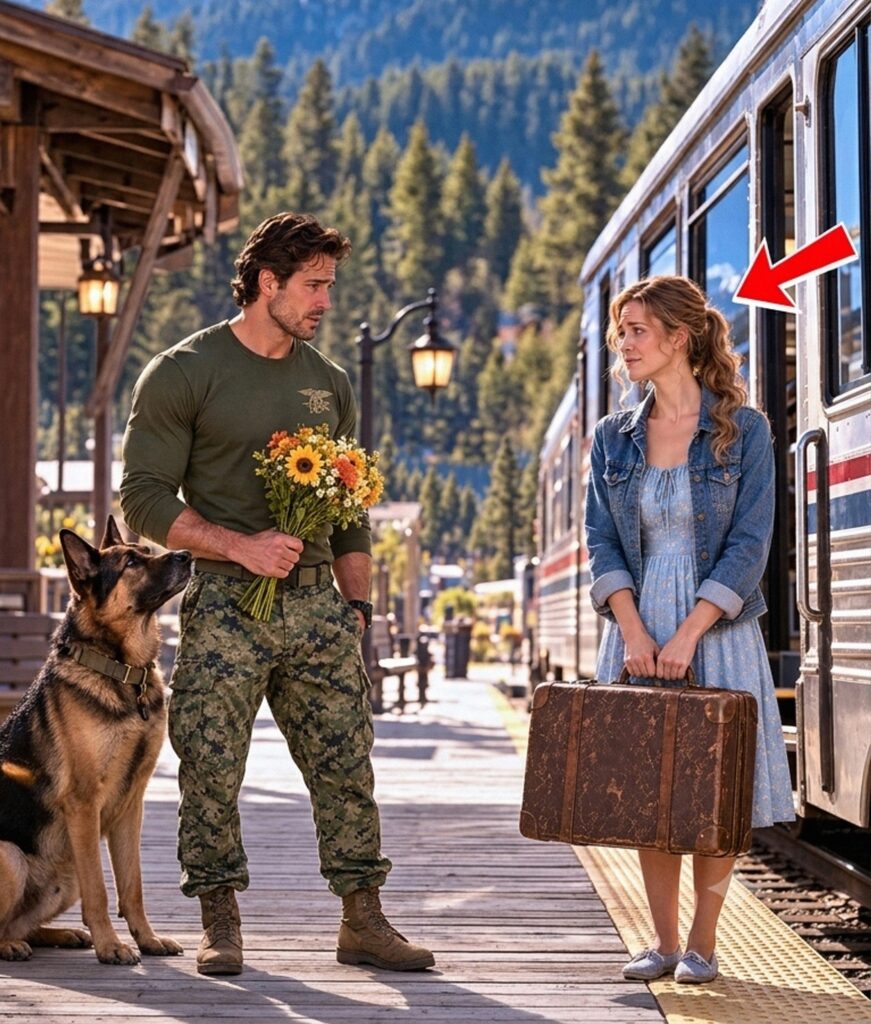
Megan had trimmed the stems of the maragolds he had given her at the station and placed them in a mason jar.
He had expected her to throw them away by now.
As May settled over the Flathead Valley, their days developed a comfortable rhythm.
Megan usually began with the purchasing records, then helped Dale with the horses on the afternoons they had scheduled for her.
Having someone take responsibility for the paperwork allowed Owen to spend more time repairing equipment and catching up on maintenance that had been neglected during the winter.
The change was noticeable, although Owen had a peculiar way of making ordinary work more complicated than it needed to be.
Years in the Navy had left him with a preference for preparation and clear instructions.
His tools were arranged before each job.
The truck was stocked the night before a long workday, and he rarely began something without deciding how he intended to finish it.
Unfortunately, he sometimes forgot that other people had not spent years learning to understand his abbreviated directions.
One morning, Megan spent 20 minutes looking for a particular fitting because Owen had told her it was in the maintenance cabinet without mentioning that he meant the cabinet in the smaller barn.
When she finally found him, she explained that a complete sentence would probably save them both a considerable amount of time.
Dale overheard the exchange and spent the rest of the morning informing Owen that civilian life was a wonderful place where people were permitted to ask questions.
Owen accepted the criticism with reasonable grace, although he continued to prefer instructions that contained as few words as possible.
Gus, meanwhile, had begun dividing his attention between the two people who now lived in the farmhouse.
He still accompanied Owen on his morning rounds, but he had discovered that Megan sometimes kept a biscuit in her desk drawer, and was considerably more willing to interrupt her work than Owen’s.
Megan also noticed that he needed longer periods of rest after accompanying Owen around the property.
The dog remained healthy and interested in everything happening around him, but 8 years had begun to make a difference.
She mentioned that the longer walks might be easier on him if Owen allowed more time for breaks.
Owen initially dismissed the suggestion, then caught Gus settling beneath a cottonwood halfway through their afternoon round.
The following day, he shortened their route.
By the middle of May, the duplicate feed payments had been corrected, and Megan had arranged more economical deliveries with the suppliers.
The improvements saved money, though Owen knew they would do little to change the larger problem waiting for him at the end of summer.
That problem arrived in a silver SUV on a Thursday afternoon.
Trevor Callahan stepped out wearing polished boots and carrying a leather folder.
At 43, Owen’s older cousin had spent most of his professional life in real estate investment, and he approached Cedar Ridge with a practical understanding of land values that rarely included what happened on the land itself.
His father had inherited a minority interest in the family business after leaving Montana, and Trevor now held 25% of Callahan Land and Cattle LLC.
He had no desire to manage cattle or spend his mornings repairing fences, but he believed his share of the property ought to produce a reasonable financial return.
Owen met him on the porch.
Megan was working at the office desk near the kitchen, close enough to hear the conversation when Trevor began discussing the latest offer from Summit Ridge Development Group.
The company wanted to purchase South Meadow, approximately 220 acres along the southern portion of Cedar Ridge for a proposed vacation property development.
Trevor considered the offer generous.
The sale would provide enough money to cover the most pressing debts and leave the company with a substantial financial cushion.
Owen understood the numbers. What Trevor continued to overlook was that South Meadow contained the ranch’s principal hay fields, its irrigation pump, and the access route used to move equipment between several working areas.
Selling it would mean purchasing more winter feed and operating the remaining property at considerably higher expense.
The immediate relief could leave Cedar Ridge in a weaker position within a few years.
Trevor placed the folder on the porch railing.
You’re protecting land you can’t afford to keep.
I’m protecting the part that helps us afford the rest.
Trevor reminded him that $95,000 was due to Cedar Basin Agricultural Lending by August 31st.
If the company failed to meet that obligation, its options would become considerably narrower, and Trevor had no intention of supporting another refinancing proposal without a convincing plan.
He was not threatening to seize the property himself.
The company had borrowed against its assets, and a payment default would place the ranch in a difficult position with its lender.
Trevor believed selling South Meadow beforehand was the sensible alternative.
Owen refused to accept the offer that afternoon.
When Trevor drove away, the silence he left behind was less comfortable than the one that had preceded his arrival.
Owen went back to work without discussing the meeting, while Megan finished the records she had been reviewing.
She had heard enough to understand that the ranch was facing a much larger problem than inefficient purchasing.
That evening, Owen brought a folder to the kitchen table after supper.
Inside were the loan documents, payment schedule, recent financial statements, and a copy of the company’s operating agreement.
He had kept the worst of the financial pressure to himself since returning home.
Partly because he considered the ranch his responsibility and partly because admitting how little progress he had made was difficult.
Megan read through the documents without interrupting him.
She had managed the books for her former business and knew the difference between an operation that was losing money and one that could no longer meet its obligations when payments came due.
Cedar Ridge still had productive land, livestock, equipment, and customers.
Its problem was that too much of its money was committed before the season’s income arrived.
She made several notes, then worked through the figures a second time.
The purchasing changes would help.
So would better planning for equipment repairs and the sale of machinery the ranch no longer needed.
Even combined, however, those measures would not produce $95,000 by the end of August.
Megan set down her pencil and asked Owen to show her the guest house.
The building stood beyond the main barn, partly sheltered by a row of cottonwoods.
Owen’s grandparents had once used its six bedrooms to accommodate relatives and visiting ranches.
But after they died, the house gradually became a place to store old furniture, spare bedding, and household items nobody wanted to discard.
Megan walked through the rooms, checking the windows, doors, floors, and plumbing.
The building needed cleaning, minor repairs, and a thorough inspection before it could accommodate paying guests, but its basic structure appeared sound.
She suggested opening a small number of rooms during the summer and expanding only if the arrangement proved worthwhile.
With Whitefish and Glacia National Park attracting visitors throughout the warmer months, she believed Cedar Ridge could offer something different from a conventional hotel, a quiet stay on a working ranch with opportunities to enjoy the surrounding countryside.
Owen was skeptical. He had grown accustomed to the privacy of Cedar Ridge, and could already imagine strangers wandering into the barns, leaving gates open, or asking him to interrupt his work for a photograph.
Megan proposed limiting the number of guests, establishing clear boundaries around the working areas, and keeping the cattle operation separate from the lodging business.
They would also need to confirm the applicable lodging requirements, insurance coverage, and building safety conditions before accepting reservations.
Dale inspected the guest house with them the next morning.
He complained about the condition of the porch railing, examined the plumbing beneath the kitchen sink, and eventually admitted that the place was in better shape than he had expected.
After comparing the necessary expenses with a conservative estimate of the possible income, Owen agreed to prepare two rooms as a trial.
The following weeks brought more work than any of them had anticipated.
Owen repaired the plumbing, replaced damaged fittings, and dealt with a bathroom door that had apparently decided it no longer wished to close properly.
Dale rebuilt part of the porch railing, insisting that the materials available 20 years earlier had been better than anything sold in town today.
Megan sorted the linens, arranged the furnishings, developed a cleaning schedule, and began preparing the online listing.
She also worked with Owen to establish rules for guests, including the areas where visitors were permitted and the arrangements for anyone interested in activities involving the horses.
Some jobs went smoothly. Others seemed determined to occupy an entire afternoon.
Owen, who could repair a heavy ranch gate without much difficulty, spent nearly 3 hours assembling a new wardrobe for one of the bedrooms.
Megan eventually discovered that he had installed one of the panels backward, and Dale offered to write a letter of complaint to the manufacturer on his behalf.
Gus contributed by lying directly in the doorway with a chew toy between his paws.
Every time someone stepped over him, he looked up as though the interruption had been entirely unnecessary.
Between those ordinary frustrations, Megan learned more about the man who owned Cedar Ridge.
Every Sunday, Owen replaced the flowers beside a photograph of his parents in the farmhouse hallway.
He called his sister in Oregon regularly, and although he rarely spoke about his years in the Navy, he sometimes mentioned people he had served with when a particular memory came naturally into conversation.
One evening, while they were carrying furniture into the guest house, Owen admitted that he had considered selling the ranch during his first months after leaving the service.
His mother had been gone, the debts were mounting, and he had struggled to adjust to a life in which the responsibilities never seemed to end.